How to Recruit Mental Health Nurses in the UK: A Guide for Healthcare Employers


Recruiting a mental health nurse is about finding more than someone with the right qualification. Healthcare employers need professionals who can combine clinical knowledge with empathy, sound judgement and the ability to remain calm when working with people who may be experiencing complex or challenging mental health needs.
For NHS trusts, private healthcare providers, mental health services and care organisations, finding the right professionals can take time. A well-planned recruitment process can make it easier to identify suitable candidates while ensuring that essential professional and pre-employment checks are not overlooked.
If you are planning mental health nurse recruitment UK employers can depend on, understanding what to look for and where to find suitable candidates is a good place to start.
Mental health nurses work in a variety of environments, including hospitals, community services, rehabilitation facilities, specialist units and residential settings. Their responsibilities can therefore differ considerably from one vacancy to another.
A nurse working in an acute mental health setting may support patients during periods of crisis, while a community mental health nurse may focus more on ongoing support, care planning and helping patients manage their conditions outside a hospital environment.
Because of these differences, employers should define the type of experience they actually need before advertising a vacancy.
For example, depending on the position, relevant experience may include the following:
The aim should not be to find a candidate who has done everything. It is to find someone whose experience is relevant to the patients, environment and responsibilities of the role.
A strong recruitment campaign begins with an accurate job description. Candidates need to understand what they will actually be doing, who they will support and what the organisation expects from them. Include details such as the clinical environment, main responsibilities, required qualifications, professional registration, working pattern, experience and development opportunities.
It is also worth separating essential requirements from desirable ones. If an employer lists too many requirements, experienced candidates who could perform well in the role may decide not to apply. A clear job description also helps recruiters screen applications more effectively.
Professional qualifications and registration are essential, but they are only part of the picture.
Mental health nursing involves regular interaction with patients who may be distressed, withdrawn, confused or experiencing a crisis. Communication and emotional intelligence can therefore be just as important as technical knowledge.
When recruiting mental health nurses, employers can explore how candidates have handled real situations.
Useful interview questions might include:
Scenario-based questions can reveal how candidates think, communicate and make decisions under pressure.
There are several ways to reach potential candidates. Healthcare job boards can attract professionals actively looking for new mental health nursing jobs, while professional networks and employee referrals can help employers reach people who may not be actively applying. Direct recruitment through an organisation’s careers page can also work well, particularly when the employer has an established healthcare brand.
For difficult-to-fill vacancies, however, specialist healthcare recruitment can provide another route. A specialist recruitment agency can use its candidate network and sector knowledge to identify professionals whose background is relevant to the vacancy.
Healthcare recruitment also requires appropriate checks before candidates are appointed.
Depending on the role and individual circumstances, employers may need to verify the following:
For registered nurses, professional registration is particularly important. Employers should ensure that the candidate meets the requirements applicable to the position before they begin working. International candidates may require additional consideration around immigration, right to work, professional registration and qualification requirements.
Because rules and guidance can change, employers should always use current official information when completing recruitment checks.
Managing recruitment internally can become difficult when an organisation has several vacancies at the same time or needs candidates with specific experience.
Selection and Hiring provides healthcare recruitment support for UK employers seeking qualified professionals across nursing and other areas of health care.
For a mental health nursing vacancy, the recruitment process can begin by understanding the employer’s actual requirements. This includes the clinical environment, experience level, working arrangements and type of professional required.
From there, Selection and Hiring can help employers connect with relevant candidates rather than simply providing a large number of unrelated applications.
This targeted approach can be particularly useful for organisations dealing with specialist vacancies or limited internal recruitment resources.
The right recruitment model depends on the employer’s workforce needs. A permanent mental health nurse may be the best option for an organisation building a long-term clinical team. Temporary recruitment can be useful when additional staff are required for a defined period, while contract recruitment may provide flexibility for specific workforce requirements.
Employers should explain the reason behind the vacancy to their recruitment partner. This allows the recruitment strategy to be built around the actual staffing need.
Recruitment is not only about assessing candidates. Employers also need to show why professionals should choose them.
When promoting mental health nursing jobs, provide useful information about:
Experienced nurses are often interested in the complete employment experience rather than salary alone.
Clear communication throughout recruitment also matters. Candidates are more likely to remain engaged when they know what happens next and receive timely updates.
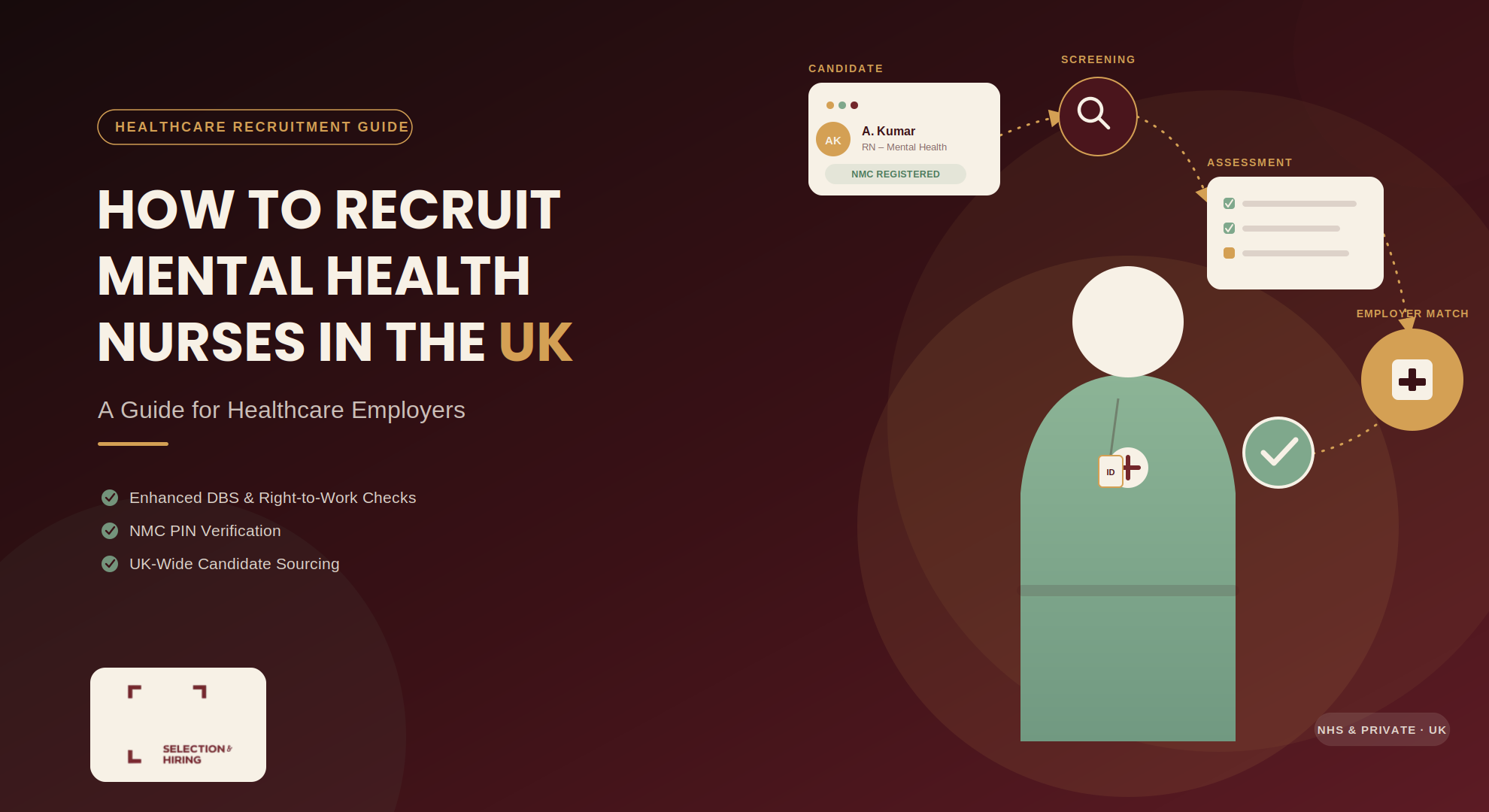
A practical approach to mental health nurse recruitment can follow these stages:
1. Define the vacancy – Identify the clinical setting, patient group and required experience.
2. Advertise strategically – Use relevant healthcare platforms, networks and recruitment channels.
3. Screen candidates – Assess qualifications, experience and suitability against the actual vacancy.
4. Interview properly – Use practical questions to understand clinical judgement and communication skills.
5. Complete checks – Verify the professional and pre-employment requirements relevant to the role.
6. Make the appointment – Once the recruitment process is complete, proceed with the appropriate employment arrangements.
7. Support onboarding – Give the successful candidate the information and support needed to settle into the organisation.
Successful mental health nurse recruitment UK employers can rely on requires a balance of specialist knowledge, careful candidate assessment and an efficient hiring process.
The strongest candidate is not necessarily the person with the longest CV. Employers should consider relevant clinical experience, communication, professional judgement and the individual’s suitability for the specific healthcare environment.
For organisations that need additional support, Selection and Hiring offers specialist healthcare recruitment solutions designed around the needs of UK employers.
Whether you are recruiting for a permanent nursing position, temporary staffing requirement or specialist healthcare vacancy, taking a targeted approach can help you reach more relevant professionals and make better-informed hiring decisions.
Employers should consider professional registration, relevant qualifications, mental health experience, communication skills, clinical judgement, teamwork and suitability for the specific patient population.
Vacancies can be promoted through healthcare job boards, NHS or private healthcare careers pages, professional networks, employee referrals and specialist recruitment agencies.
A specialist recruiter can provide access to relevant candidates while bringing knowledge of healthcare roles and the challenges involved in sourcing professionals with specific experience.
Yes. Selection and Hiring supports UK employers with healthcare recruitment, including nursing and specialist healthcare staffing requirements.
Depending on the position and candidate, employers may need to complete identity, right-to-work, professional registration, qualification, reference, employment history and DBS checks.