How to Recruit Specialist Nurses for Hard-to-Fill Healthcare Roles in the UK

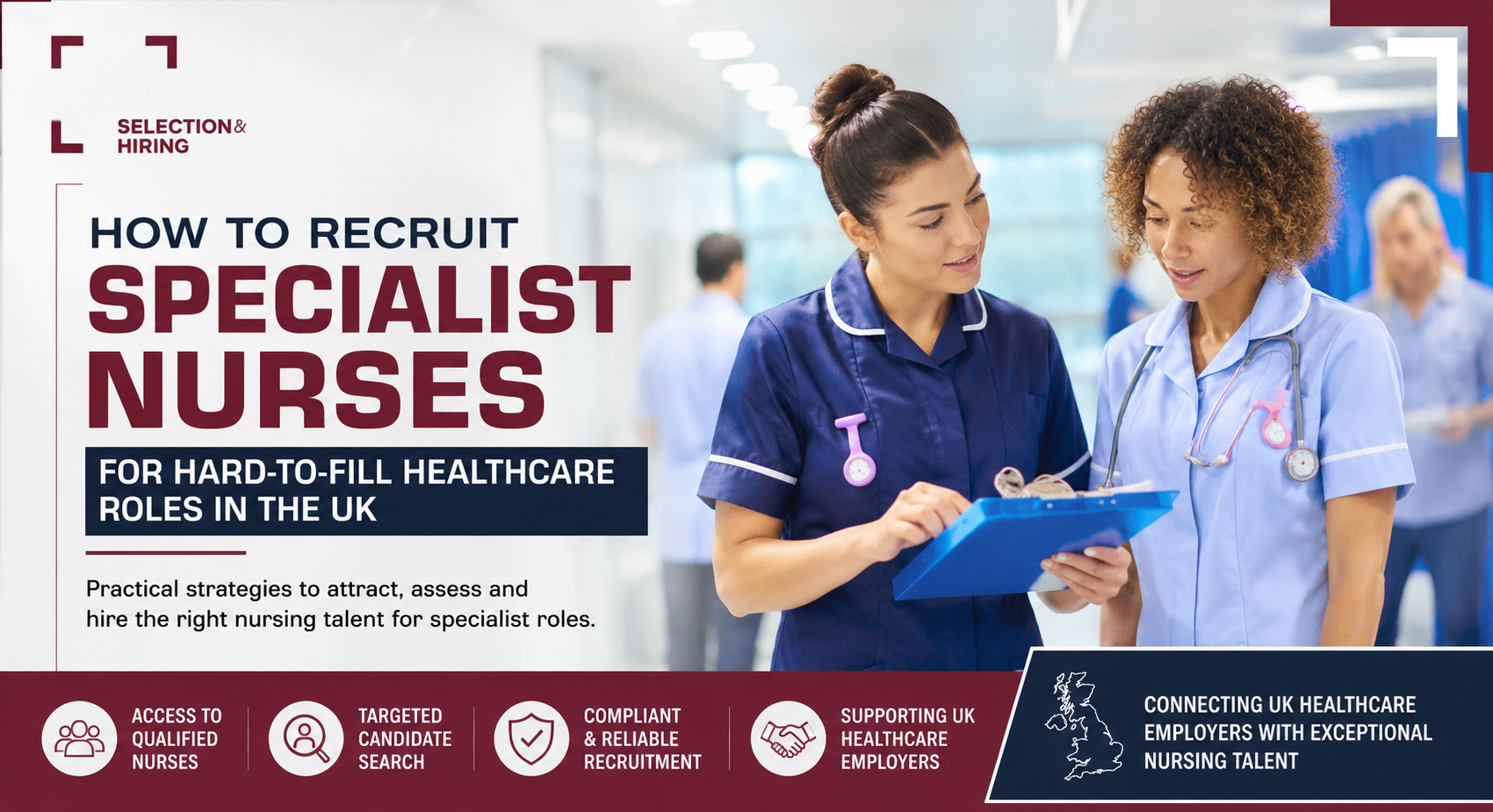

Recruiting nurses is challenging enough when there is a healthy pool of applicants. Finding experienced professionals for specialist nursing positions can be considerably harder.
Healthcare employers may be competing for nurses with highly specific clinical skills, relevant experience, and the ability to work in demanding environments. At the same time, candidates may have several employment options, making it important for employers to offer more than simply a job vacancy.
A successful recruitment strategy needs to identify the right professionals, communicate the opportunity clearly, and create a recruitment process that respects candidates’ time and expectations.
This guide explains how UK healthcare employers can approach specialist nurse recruitment in the UK, from defining the role and finding suitable candidates to assessing applications and improving the overall hiring experience.
Specialist nurse recruitment focuses on finding qualified nursing professionals who have the knowledge, clinical experience, and skills required for a particular area of healthcare.
Unlike general nursing recruitment, specialist positions may require experience in a specific clinical environment or patient group.
Depending on the organization, specialist roles can include areas such as
The exact requirements will depend on the role, employer, and clinical setting.
For employers, the challenge is not simply finding a nurse with the correct title. It is finding someone whose professional background genuinely matches the responsibilities of the position.
There is no single reason why a specialist vacancy can remain open for a long time.
Often, several factors are involved.
The more specific the clinical requirements, the smaller the potential candidate pool may become.
An employer looking for a nurse with several years of experience in a particular specialty cannot necessarily consider every registered nurse.
Experienced nurses may have opportunities from multiple healthcare providers.
If an organization’s recruitment process is slow or unclear, a strong candidate may accept another position before the employer reaches the final stage.
Some specialist positions require candidates to demonstrate substantial practical experience.
This can make recruitment particularly difficult when employers need someone who can contribute with relatively little additional training.
Location can also influence candidate availability.
A specialist nurse may be interested in a particular position but unwilling or unable to travel a significant distance for work.
Experienced healthcare professionals increasingly consider the complete employment opportunity.
Salary is important, but candidates may also consider:
Employers that communicate these factors clearly can make their vacancies more competitive.
One of the biggest mistakes in recruitment is starting the search before defining exactly what the organisation needs.
Before advertising a specialist nursing vacancy, hiring managers should create a clear candidate profile.
Consider:
Essential qualifications:
Which qualifications or professional requirements are genuinely necessary?
Clinical experience:
How much experience does the candidate need, and in which speciality?
Technical skills:
Are there specific procedures, systems or clinical competencies required?
Soft skills:
Does the role require leadership, communication, decision-making or mentoring abilities?
Working requirements:
Are there specific shifts, on-call responsibilities or weekend requirements?
Personal qualities:
What behaviours would help someone succeed within the team?
Separating essential requirements from desirable qualities is particularly important.
If an employer lists too many requirements as mandatory, suitable candidates may decide not to apply.
A useful recruitment strategy asks:
“What does this person absolutely need to be able to do from day one?”
Rather than:
“What would the perfect candidate look like?”
For example, a healthcare employer may require specific clinical experience but be willing to provide training in an internal system or process.
Being realistic about the role can significantly expand the potential candidate pool without lowering professional standards.
Finding the right candidates often requires more than publishing a vacancy on one platform.
Healthcare employers can consider a combination of channels, including the following:
An organisation can advertise vacancies through its own website and recruitment channels.
This approach can work particularly well when the employer has an established reputation and a strong candidate network.
Professional networking can help employers reach passive candidates who are not actively searching job boards.
A specialist nurse may not be looking for a new role today but could be interested in the right opportunity.
Existing employees can sometimes introduce suitable professionals within their professional networks.
A structured referral programme can support recruitment while helping organisations reach candidates who may not otherwise see the vacancy.
A specialist recruitment partner can help employers reach candidates who are difficult to find through traditional advertising.
This can be particularly useful for urgent or highly specialised vacancies.
The best approach depends on the role, location, candidate availability and recruitment timeline.
A job advertisement is often the candidate’s first impression of an employer.
Generic wording can make an interesting opportunity look ordinary.
Instead of simply listing responsibilities, explain why the role is worth considering.
A strong vacancy should clearly communicate the following:
Most importantly, avoid hiding important information.
If a role involves night shifts, weekend work or a specific location, candidates should know this before investing time in the application.
A lengthy and confusing application process can discourage experienced professionals.
This is especially important when recruiting specialist nurses because candidates may already be working full-time.
Employers should review their application journey and ask the following:
A smoother process can help employers retain the interest of suitable candidates.
Effective candidate screening is about determining whether someone genuinely fits the role.
For specialist nursing positions, employers may need to assess the following:
Screening should be structured around the actual requirements of the vacancy.
Avoid rejecting potentially strong candidates simply because their career history does not look identical to the person specification.
Transferable experience can sometimes be highly valuable.
Interviews should provide a consistent way to compare candidates.
Rather than relying entirely on informal conversation, employers can prepare questions around the key competencies required for the position.
For example, candidates could be asked to explain how they have:
The questions should reflect the actual responsibilities of the role.
For senior or highly specialised positions, employers may also use competency-based assessments or other appropriate selection methods.
Recruitment is a two-way process.
While employers are assessing candidates, candidates are also deciding whether they want to work for the organisation.
A strong healthcare staffing UK strategy therefore needs to consider the candidate experience from the first interaction.
Small improvements can make a noticeable difference:
Tell candidates what happens next and when they can expect an update.
Long periods without communication can cause candidates to lose interest.
Candidates appreciate accurate information about working conditions, responsibilities and expectations.
Where possible, make interviews and assessments focused and well organised.
Even when a candidate is unsuccessful, respectful communication can leave a positive impression of the organisation.
One of the most effective ways to address difficult recruitment is to stop thinking about recruitment as a one-off activity.
Healthcare organisations can build longer-term talent pipelines by maintaining relationships with suitable professionals.
This might involve:
A candidate who is unavailable today may become an excellent hire several months later.
Recruitment and retention are closely connected.
If an organisation repeatedly struggles to fill the same specialist nursing position, it may be worth asking why.
Potential issues could include:
Recruiting more people without addressing underlying retention issues can create a cycle where vacancies continue to return.
The strongest recruitment strategy therefore considers what will make a qualified nurse want to stay, not simply what will make them accept an offer.
When an organisation has exhausted its usual recruitment channels, a specialist recruitment agency can provide additional reach.
Recruitment agencies can support employers by:
This can be particularly useful when internal HR teams are managing multiple vacancies or when a specialist position requires a relatively small candidate pool.
However, employers should choose recruitment partners carefully.
A good agency should understand the healthcare sector and the specific requirements of the vacancy rather than simply sending large numbers of unrelated CVs.
Before working with a recruitment provider, healthcare organisations should consider:
Does the recruiter understand healthcare roles and terminology?
Does the agency focus on relevant candidates rather than simply quantity?
Will the recruitment team provide regular updates?
Does the recruiter take time to understand the clinical and organisational requirements?
Are responsibilities between the employer and recruitment partner clearly defined?
Does the agency represent the employer appropriately when communicating with candidates?
These factors can have a significant impact on the success of a recruitment campaign.
Selection and Hiring provides recruitment support for organisations looking to connect with suitable healthcare professionals in the UK.
For employers dealing with specialist or difficult-to-fill nursing vacancies, access to an appropriate candidate network can help broaden the search and reduce the pressure on internal recruitment teams.
The objective should not simply be to send more CVs. It should be to identify candidates whose experience and professional background align with the requirements of the vacancy.
Selection and Hiring can help healthcare employers approach recruitment with a more targeted strategy, particularly when finding suitable professionals through traditional channels has become difficult.
For the best results, employers should provide a clear job specification, realistic expectations and timely feedback throughout the recruitment process.
For healthcare employers planning their next recruitment campaign, the following approach can provide a useful starting point:
Identify the clinical, professional and practical requirements.
Avoid making every preference a mandatory requirement.
Understand how available the required skills are in the target location.
Explain the role, expectations, benefits and working environment clearly.
Combine direct recruitment, professional networks, referrals and specialist recruitment support where appropriate.
Assess candidates against the actual requirements of the position.
Avoid unnecessary delays between application, interview and decision stages.
Make sure relevant employment, professional and pre-employment requirements are addressed before appointment.
Consider the full employment package rather than salary alone.
A strong candidate experience can support both immediate recruitment and future hiring.
Healthcare employers should look beyond simply asking whether a vacancy was filled.
Useful recruitment measures can include:
These measures can help employers understand which parts of their recruitment strategy are working and where improvements are needed.
For example, if an organisation receives many applications but very few suitable candidates, the problem may be the targeting of the vacancy rather than the number of applicants.
Being overly restrictive can exclude candidates with valuable transferable experience.
The best specialist candidates may not be actively searching job boards.
Experienced professionals may move quickly when they have multiple opportunities.
A vague advertisement makes it difficult for candidates to understand why they should apply.
Poor communication can damage an employer’s reputation and cause suitable candidates to withdraw.
A technically qualified candidate may still leave quickly if the workplace does not meet their expectations.
Specialist nurse recruitment involves finding and appointing nursing professionals with the specific clinical knowledge, qualifications and experience required for specialised healthcare positions.
The candidate pool can be smaller because specialist roles often require particular clinical experience or competencies. Competition between healthcare employers, location and candidate expectations can also affect recruitment.
Employers can combine direct advertising, professional networks, employee referrals, targeted outreach and specialist recruitment agencies to reach suitable candidates.
A strong strategy combines a clear candidate profile, realistic job requirements, targeted sourcing, efficient screening, structured interviews, good candidate communication and competitive employment conditions.
Yes. A suitable healthcare recruitment agency can expand the candidate search, identify relevant professionals and support parts of the recruitment process.
Employers can improve candidate experience by providing accurate job information, communicating promptly, making applications straightforward and keeping candidates informed throughout the recruitment process.
Recruiting specialist nurses requires a more targeted approach than simply advertising a vacancy and waiting for applications.
The strongest specialist nurse recruitment UK strategies begin with a clear understanding of the role and the type of professional needed. From there, employers can use multiple sourcing channels, communicate the opportunity effectively and create a recruitment process that respects candidates’ time.
For hard-to-fill nursing roles, flexibility and persistence are particularly important. Employers should be willing to consider transferable experience while maintaining the professional standards required for the position.
Most importantly, recruitment should not be separated from retention. A healthcare organisation that understands what specialist nurses value is in a much stronger position to attract and keep the professionals it needs.
For organisations that need additional recruitment support, Selection and Hiring can help connect UK healthcare employers with relevant professionals and provide a more targeted approach to difficult recruitment campaigns.
Need help filling a specialist healthcare vacancy?
Speak with Selection & Hiring about your current recruitment requirements and explore how a targeted recruitment strategy can help you reach suitable candidates.